
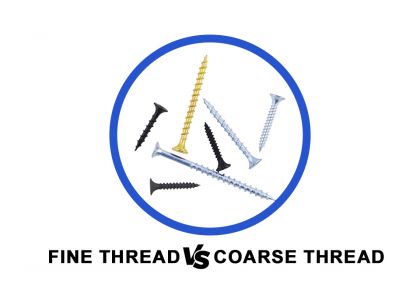
The main differences between fine-threaded and coarse-threaded screws lie in the pitch, depth of the threads, the materials they are suitable for, as well as the torque and load-bearing capacity.
1. Pitch and Thread Depth
The pitch of fine-threaded screws is relatively small, meaning the distance between two adjacent threads is closer, while the thread depth is relatively shallow. In contrast, the pitch of coarse-threaded screws is larger and the thread depth is deeper. This difference directly affects the connection performance and applicable scenarios of the screws.
2. Applicable Materials
Due to the smaller pitch and shallower thread depth of fine-threaded screws, they are more suitable for connecting thin sheet materials because these materials require less torque during connection. On the other hand, coarse-threaded screws, with their larger pitch and deeper thread depth, can provide greater torque and load-bearing capacity, making them more suitable for connecting thick sheet materials.
3. Torque and Load-Bearing Capacity
Coarse-threaded screws, due to their pitch and thread depth advantages, can withstand greater torque and load, which makes them excellent in scenarios requiring high-strength connections. Fine-threaded screws, although having relatively weaker torque and load-bearing capacity, are more suitable for scenarios requiring fine adjustment or connecting thin sheet materials.
4. Industry Standards and Application Scenarios
In industry standards, both fine-threaded and coarse-threaded screws have clear application specifications. Fine-threaded screws are commonly used in precision instruments, electronic equipment, etc., while coarse-threaded screws are more often used in construction, machinery, etc., where high-strength connections are required.

 1
1