
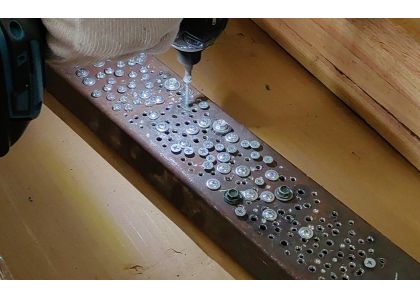
The distinctive feature of drill point screws lies in their self-drilling head at the front end. This design enables drill point screws to drill, tap, and lock directly onto the specified material or base material without the need for additional processing, significantly reducing construction time. Application fields
Self-drilling screws play a crucial role in various fields such as railway infrastructure, doors and windows curtain walls, photovoltaic systems, steel structures, and high-rise buildings. They are commonly used for connecting and fastening various structures and providing stable support in harsh environments.
1. The application of stainless steel plates, metal plates, and galvanized steel plates in engineering installation;
2. Indoor and outdoor installation requirements for metal curtain walls, metal light partitions, plastic-steel doors and windows, etc.;
3. The combination installation of angle steel, channel steel, iron plates and other metal materials;
4. Assembly projects in automotive compartments, container boxes, shipbuilding, refrigeration equipment, and environmental engineering, etc.
In addition, self-drilling screws have different materials and lengths. The materials mainly include iron and stainless steel, and the specific length can be determined according to actual needs.
When choosing self-drilling screws, the following factors need to be considered:
The design of the two grooves on the drill tip is intended to discharge the drilling. The length of the grooves is crucial as it determines the maximum thickness of the material that can be drilled. To ensure smooth discharge of the drilling, the thickness of the material must be less than the length of the grooves.
When attempting to drill through two layers of materials with self-drilling screws, it is recommended to make a hole on the first layer of material first, unless the first layer is very thin. Otherwise, if the first layer is thick, forcibly drilling continuously may cause the screw rod to break, similar to tightening two nuts simultaneously on a screw rod.
When using self-drilling screws, the initial drilling speed should not be too fast to avoid overheating and ablation of the drill tip.
Next, let's explore the significant advantages of self-drilling screws.
Compared to ordinary screws, self-drilling screws exhibit higher tensile strength and retention force, ensuring that the combination does not loosen for a long time and using them is more reassuring. Their unique design also allows for drilling and tapping to be completed at one time, which is simple and efficient to operate. In the combined applications in numerous places such as construction and residences, self-drilling screws have become the preferred fastener due to their excellent workability and economy.

 1
1