
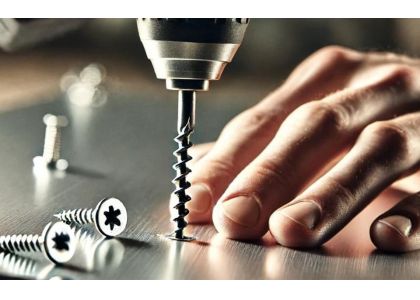
In the field of mechanical and engineering, screws, as key components for connection and fixation, their surface treatment methods not only affect the appearance of the screws, but are also crucial for their service life and performance. The correct surface treatment method can enhance the corrosion resistance, wear resistance, and fatigue strength of the screws, thereby prolonging their service life and ensuring the stable operation of the equipment.
Blackening treatment is achieved through a chemical reaction to form an oxide film on the surface of the screws, typically presenting as black or bluish-black. This treatment method is cost-effective and can improve the corrosion resistance of the screws to a certain extent, while also having a certain degree of aesthetics. However, its corrosion resistance is relatively weak, and it is prone to failure in harsh environments, and the torque and preload consistency are poor.
Galvanizing treatment is achieved by depositing a layer of zinc on the surface of the screws to enhance their corrosion resistance and aesthetics. Depending on the process, galvanizing can be divided into hot galvanizing and electro-galvanizing. Hot galvanizing forms a thicker zinc layer, suitable for corrosion requirements in harsh environments; electro-galvanizing forms a thinner zinc layer, suitable for decoration and mild corrosion in general environments. Galvanizing treatment can significantly enhance the corrosion resistance of the screws, with a smooth surface and uniform color, but it is relatively costly and may cause environmental issues.
Dacromet treatment is a new type of surface treatment technology, using zinc powder, aluminum powder, chromic acid, and deionized water as main components, forming a dense dacromet coating on the surface of the screws through immersion, centrifugation, and heating processes. This coating has extremely strong corrosion resistance, with a rust prevention effect 7-10 times higher than traditional electro-galvanizing, hot galvanizing, or coating methods, and has no hydrogen embrittlement phenomenon, suitable for stressed components. In addition, the dacromet coating can withstand high-temperature corrosion, with a heat resistance temperature of over 300°C, and has good adhesion and re-coating performance. However, the dacromet treatment process is relatively complex, costs are high, and the color is relatively monotonous.
Electroplating is to immerse the screws in an aqueous solution containing the deposited metal compound, and through the action of an electric current, the electroplated metal is deposited and formed on the surface of the screws. Common electroplating treatments include copper plating, nickel plating, and chromium plating. Electroplating treatment can enhance the corrosion resistance, wear resistance, and aesthetics of the screws, but the cost varies depending on the type of electroplated metal.
Painting treatment uses a spray gun to evenly spray a colored thin layer on the surface of the screws, mainly for beautifying the appearance of the screws and providing certain corrosion resistance, but it is relatively weak.
Phosphating treatment involves immersing the screws in a phosphating solution to form a phosphating film on the surface. The phosphating film can enhance the corrosion resistance of the screws, but usually requires oil coating to enhance the corrosion prevention effect.
Cadmium plating treatment is achieved by electroplating a layer of cadmium on the surface of the screws, with better rust prevention performance and durability, but the processing process requires large costs for waste liquid treatment, and the cost is high.

 1
1