
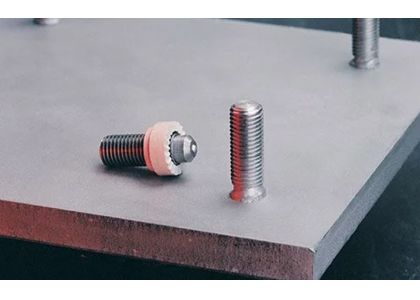
I. Working principle of welding screws
The core of welding screws is to fuse the screw with the substrate through high temperature, forming a long-lasting connection. Depending on the welding method, it mainly falls into the following two categories:
Resistance welding screws: Utilizing the resistance heat generated by current passing through the contact surface (temperature can reach 1200-1500℃), causing local melting of the metal. For example, the convex welding screws commonly used in the automotive industry, the welding time is usually 0.1-0.5 seconds, and the pressure needs to reach 200-500N.
Arc welding screws: Through arc discharge to generate high temperature (about 3000℃), melting the end of the screw and the substrate. Suitable for thick plates or connection of different metals, such as the welding of screws for wind turbine towers.
During the welding process, three key parameters need to be controlled: current (such as resistance welding commonly uses 5-20kA), time (0.05-1 second), and pressure (100-1000N). Otherwise, it is prone to cause false welding or burn-through.
II. Unique advantages of welding screws
Compared with traditional threaded fasteners, welding screws have:
Strong vibration resistance: The metallurgical bonding avoids the risk of bolt loosening, suitable for dynamic load scenarios such as high-speed rail track fasteners.
Space saving: No need for back operation, the assembly of car chassis can reduce 30% installation space.
High load-bearing capacity: The strength of the welded joint can reach more than 90% of the substrate, such as the welding screws for Q235 steel have an anti-tensile strength of ≥400MPa.
III. Typical application scenarios and selection guidelines
Automobile manufacturing:
Application: Body panels, battery box fixation.
Selection: Galvanized screws for rust prevention, welding current 8-12kA.
Building steel structure:
Application: Steel beam connection, curtain wall support.
Selection: Needs to match the carbon equivalent of the substrate.
Appliances and electronics:
Application: Washing machine inner cylinder, circuit board grounding.
Selection: Use capacitively discharged welding to avoid thermal deformation.
IV. Precautions and future trends
Quality inspection: Need to conduct tensile tests and visual inspection (no pores, cracks).
Emerging technologies: Laser welding screws have higher accuracy (error ±0.1mm) and have been used in precision medical devices.

 1
1