
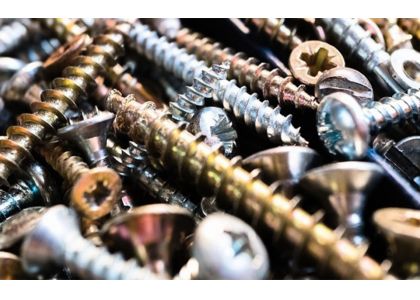
Screws, a common item in daily life, often pose a challenge in terms of material selection. Although we can perceive the differences between various materials through our eyes and touch, it is not easy to deeply understand the unique properties of each material and its application fields.
The commonly used materials for screws include copper, aluminum, stainless steel, carbon steel, and titanium, among others. Among them, copper has various types, including pure copper and brass; carbon steel is divided into low carbon, medium carbon, and high carbon, and is used for products with different hardness requirements; stainless steel is renowned for its excellent rust resistance and has different types available.
Copper is one of the commonly used materials in the screw industry. Copper has a wide variety of types, including pure copper, oxygen-free copper, and phosphorus-deoxidized copper. In addition, there are types such as brass, red copper, and bronze.
Carbon steel, also known as iron screws, is another major category of commonly used materials. Carbon steel screws are divided into low carbon steel, medium carbon steel, and high carbon steel. The differences between these types mainly lie in the hardness grade. For example, low carbon steel is mainly used for products without hardness requirements; while medium carbon steel is suitable for occasions requiring higher hardness.
Stainless steel is also an important screw material. Stainless steel screws have excellent rust resistance and a surface that is easy to process.
Different materials of screws are suitable for various occasions. For example, copper screws are often used in electrical equipment, stainless steel screws are used in outdoor and humid environments, and carbon steel screws are commonly used in the construction industry. Whether in electronic products, mechanical products, digital products, power equipment, or in water conservancy projects, chemical experiments, etc., screws play an indispensable role. It can be said that screws are an indispensable cornerstone in industrial production.
Screws utilize the principles of inclined circular rotation and friction force in physics and mathematics to achieve the tight connection of objects and components. Screws achieve mechanical tightening through inclined circular rotation and friction force and are key components in industrial production. They play an important role in both small equipment and large buildings.
The types of screws are diverse, ranging from tiny screws like those used in eyeglasses to large screws used in heavy electrical engineering. Their shapes vary. And the precision of screws also differs, meeting various different needs.

 1
1