
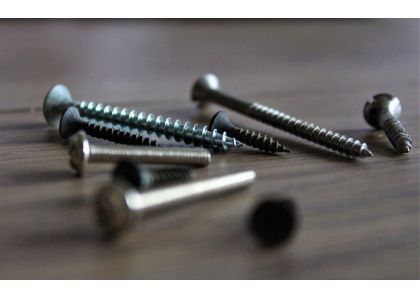
Screws are essential basic fasteners in industrial production, construction and everyday scenarios. Machine screws and ordinary screws are similar in appearance, but there are essential differences in design logic and application scenarios, and the selection of the type directly affects the stability and efficiency of the connection.
Differences between core definition and design logic
Machine screw, also known as machine screw, machine tooth screw, is a standardized fastener for precision fastening. Its core role is to connect parts with through holes and parts with internal threads, or cooperate with nuts to achieve multi-part fixation, which is a removable connection scheme. Its design core revolves around "precise meshing", the thread is evenly distributed and almost covers the whole rod, the diameter is consistent from head to tail, the tail is flat and has no cutting function, and depends on the perfect match with the prefabricated thread to achieve fixation.
Ordinary screws (typically self-tapping screws) are mainly convenient to fit, do not need to rely on prefabricated threads, and can self-shape threads in soft materials through their own structure. The core of the design is "self-cutting", with a sharp cutting edge at the end and a thicker and deeper thread, which can penetrate the material and form an adaptation thread during the screwing process, eliminating the need for additional tapping steps.
The intuitive difference of structural features
Thread design: the machine screw thread is fine and uniform, the pitch is consistent, and the thread is concentrated at the end of the rod, which is suitable for the occlusal demand of soft materials.
Tail shape: the tail of the machine screw is flat or round head, no cutting function, need to be aligned with the prefabricated thread hole. Common screw tail sharp like drill, part with drill type design, can directly penetrate wood, plastic, thin steel and other materials.
Head style: machine screw head type is rich, including hexagon head, hexagon head, cross slot head, suitable for wrench, screwdriver and other professional tools, to meet the needs of different operating space; Common screw head for the cross slot or slot, in order to adapt to the electric screwdriver and other common tools, taking into account the convenience.
Installation process and efficiency comparison
The installation of machine screws needs to follow the multi-step process of "drilling - tapping - screing". First, the drill is used to punch the hole, then the tap is used to process the internal thread, and finally the screw is screwed in. In some scenes, it needs to be reinforced with the nut, which requires high operation accuracy, but the required torque is small. This process determines that its single piece installation efficiency is low, but the connection accuracy and stability are better, and it is suitable for precision assembly scenarios.
Ordinary screw installation process is extremely simple, only "position-vertical screw" step, no tapping link, with sharp tail and self-tapping thread directly through the material and forming the thread. Installation requires a large torque, can be combined with electric screwdriver to achieve batch operation, efficiency is far better than machine screws, especially suitable for assembly line production.
Material selection and application scene division
Adaptation scenario of machine screws
The material of machine screw is mainly high strength and corrosion resistance, common stainless steel, carbon steel (galvanized/chrome plated), brass, aluminum alloy, etc. Stainless steel and alloy steel are suitable for heavy load scenes, and brass is suitable for electronic equipment because of its conductivity. Its core applications focus on:
Machinery manufacturing: engine cylinder, machine parts and other heavy load or moving parts fixed;
Electronic equipment: assembly of circuit boards, computer hardware and other precision components;
Steel construction: high strength connection of metal frame and modular furniture;
Aerospace, medical equipment: high precision and stability requirements of the core components fastening.
Adaptation scenario for common screws
Ordinary screw material also covers steel, stainless steel, brass, etc., but more emphasis on versatility and cost balance, surface galvanized treatment can improve the rust prevention ability of the foundation. Its application scenarios are mainly soft materials and lightweight connections:
woodworking: furniture frames, cabinets, wooden doors and other wood connections;
Light construction: color steel roof, dry wall installation, doors and Windows fixed;
Home appliance assembly: washing machine shell, refrigerator condenser and other non-core components fixed;
Plastic parts assembly, small shelf installation and other daily scenes.
Comprehensive consideration of performance and cost
In terms of connection performance, the machine screw is designed with full mesh thread, high connection strength, good vibration resistance, can be repeatedly removed and used without damage to the thread, long-term reliability is outstanding, suitable for heavy load and precision scenes; Ordinary screw connection strength is medium, can only withstand light load, repeated removal is easy to lead to thread wear, more suitable for one-time or temporary fixed scenarios.
In terms of cost, machine screws require high processing accuracy, and the cost of a single piece is slightly higher than that of ordinary screws, but the installation labor cost is higher. Ordinary screws have low unit price, high installation efficiency, can significantly save labor time, and have more advantages in comprehensive cost, especially suitable for mass application scenarios.

 1
1