
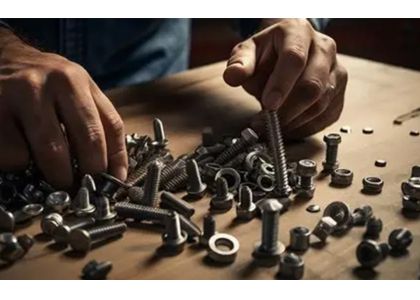
Bolt: The bolt is composed of two parts: the head and the cylinder with an external thread (namely the screw). It needs to be used in conjunction with a nut for connecting two parts with vias. This form of connection is called bolt connection and belongs to removable connection. Bolts are usually used to anchor the jointed piece to a hardened concrete substrate.
Stud: The stud has no head, only both ends with external threads of a class of fasteners. When connecting, one end is screwed into the part with an internal threaded hole, the other end is passed through the part with a through hole, and then the nut is screwed to make the two parts tightly connected into a whole. It is mainly used for occasions with large thickness or frequent disassembly.
Screw: Screw is a general term for fasteners, which refers to tools that gradually tighten objects by using the circular rotation of the inclined surface of the object and the principle of friction. The screw is small, the head has a flat head, cross head, etc., the rod part with external thread.
How to choose the right type of fastener (bolt, stud, screw) according to different connection requirements?
Choosing the right type of fastener (bolt, stud, screw) needs to be considered according to different connection requirements. The following are the detailed steps and precautions: 1. Determine the category: standard fasteners are divided into multiple categories, and the selection should be determined according to their use occasions and functions. Bolts are usually used for removable connections, usually in conjunction with nuts, and may add washers to enhance the connection strength. 2. Consider load requirements: When choosing bolts, first consider the required load capacity, that is, the maximum force the bolt can withstand. Different types of fasteners have different carrying capacities, so make sure that the selected fasteners can meet the load requirements in the actual application. 3. Material selection: the material selection of fasteners is also very important, different materials are suitable for different environments and conditions. For example, certain fasteners with high strength or corrosion resistance may be more suitable for specific application scenarios. 4. Length and specification: It is key to determine the length and specification of the fastener, which depends on the thickness of the connected component as well as the required preload. The length should be chosen to ensure that the fastener can fully enter the jointed piece while providing sufficient support. 5. Stress environment: fasteners used in high stress environments require special attention to their tensile strength and fatigue life. For applications that bear repetitive loads or high impact forces, fasteners with higher strength and better fatigue resistance should be selected. 6. Installation location and method: depending on the installation location, it may be necessary to choose bolts with different head shapes, such as hexagonal head or large hexagonal head. Specially designed fasteners, such as bolts with holes, can be used to prevent bolts from loosening or rotating.

 1
1