
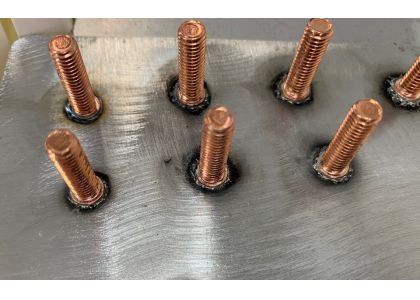
I. What is a Welding Screw
A welding screw is a special fastener that is fixed to the substrate through welding. Its head is designed to facilitate the welding process, while the tail has threads for connecting other components. Compared to ordinary screws, welding screws provide a more secure connection after installation, especially suitable for situations that require significant vibration or load. Common welding methods include spot welding, projection welding, and arc welding, and the choice of method depends on the type of substrate and specific application requirements.
II. Main Types of Welding Screws
Projection Welding Screw: The head has a protrusion, and during welding, the protruding part melts first, forming a secure connection. It is suitable for thin sheet materials, with fast welding speed and little deformation.
Spot Welding Screw: Welded using a spot welding machine, suitable for automated production scenarios. It has high installation efficiency, but has certain requirements for the thickness of the substrate.
Arc Welding Screw: Uses the arc welding process, with high connection strength, suitable for thick plates or heavy structures. However, the welding temperature is relatively high, which may affect the performance of the substrate.
III. How to Choose the Right Welding Screw
When choosing a welding screw, several factors need to be considered: first, the characteristics of the substrate, including material, thickness, and surface treatment; second, the application environment, such as whether waterproof, corrosion-resistant, or heat-resistant is required; finally, the load requirements, including static and dynamic loads. Additionally, the installation method is also important. Automated production lines are more suitable for spot welding screws, while on-site maintenance may prefer arc welding screws.

 1
1