
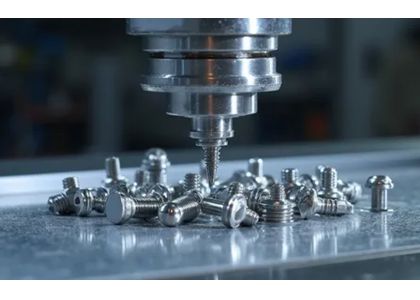
In high-end manufacturing and extreme environment applications, the performance of fasteners often determines the reliability and life cycle of the overall equipment. As a high-performance fastener with pure titanium or titanium alloy as raw material, titanium screws break through the performance limitations of traditional steel and stainless steel screws by virtue of its unique material characteristics, and become the core choice in aerospace, new energy, medical and other fields. Its advantages and characteristics are reflected in the following key dimensions.
The perfect balance of lightweight and high specific strength
The density of titanium is only 4.5g/cm³, about 60% of the steel, and the weight of steel screws can be reduced by 40%-50% compared with titanium screws. This lightweight advantage is of significant value in weight-sensitive scenarios. The use of titanium screws for spacecraft can directly reduce the launch cost, and the battery pack of new energy vehicles is fixed with titanium screws, which can reduce the weight of the bicycle by up to 9kg, and then improve the driving range by 2.2%. More rare is that lightweight does not at the cost of the sacrifice of strength -- TC4 titanium alloy screw tensile strength of 900-1400MPa, and 10.9 grade high strength steel is equivalent, and its specific strength (strength/density) is 2.5 times that of stainless steel, in the weight loss at the same time to achieve a high load of stability.
Super adaptability in extreme environments
The corrosion resistance of titanium screws can be called the industry benchmark. Its surface can naturally form a layer of dense and stable TiO₂ oxide film. This layer of "protective shield" can prevent the penetration of corrosive media, even in harsh environments such as seawater and strong acid and alkali chemical media, it can remain stable. In terms of temperature adaptability, titanium screws also perform well, which can work stably in the extreme temperature area of -253℃ to 550℃. Metal cold brittleness will not appear at low temperature, and core mechanical properties can still be maintained in high temperature environment, which is perfectly suitable for special scenes such as aero-engine hot zone and deep-sea detection equipment. In addition, titanium remains absolutely non-magnetic over a wide temperature range and can avoid electromagnetic interference, making it an ideal fastener for electromagnetic sensitive products such as 5G equipment and precision instruments.
Biocompatibility and adaptability to multiple scenarios
The biocompatibility of titanium screws is an irreplaceable core advantage in the medical field. The implant grade titanium screw has no nickel release, cytotoxicity level 0, elastic modulus close to human bone (about 110GPa), which can effectively avoid stress shielding effect, and will not cause rejection reaction after long-term implantation in human body. It is widely used in orthopedic locking screws, dental implants and other medical implants. This adaptability also extends to the multi-material connection scene. When titanium screws are in contact with different metals such as aluminum and magnesium alloys, special coatings or spacers can effectively prevent galvanization corrosion, especially suitable for the connection needs of high-end equipment such as carbon fiber frames and aviation structural parts. At the same time, through surface treatment processes such as anodic oxidation and micro-arc oxidation, titanium screws can generate customized colors such as blue, gold and purple, taking into account both functional and aesthetic requirements, which is favored in high-end consumer electronics, competitive sports equipment and other fields.
Long durability and low maintenance cost
The fatigue resistance of titanium alloy itself is excellent, the preload holding rate is still more than 90% after 10⁷ times vibration cycle, which is much better than the traditional steel, and can effectively resist the structural loss caused by high-frequency vibration. Its excellent corrosion resistance and stability, so that titanium screws in the use of the process without additional anti-rust treatment or regular maintenance, service life of steel screws up to 3-5 times, in the long run can significantly reduce equipment maintenance costs and replacement frequency.

 1
1